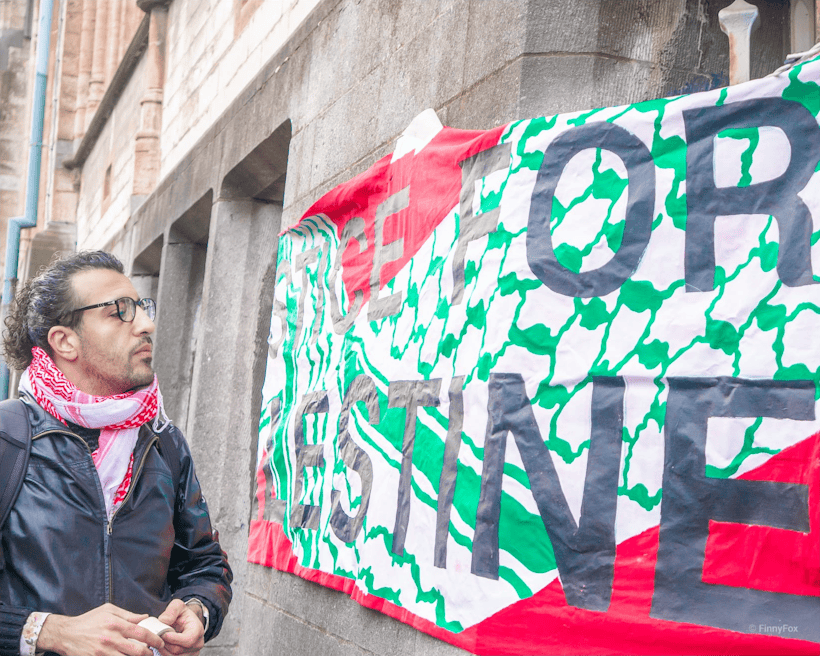
Hi Ahmed, we met during a recent action in solidarity with pro-Palestinian activists sued by OIP, a Belgian company owned by Elbit Systems, the main national arms supplier of the zionist occupation army. OIP is thus an integral part of the zionist genocide industry, which is why activists decided to block its production site in Oudenaarde on 4 March 2024. On 17 February 2026, the legal hearing took place, and people gathered in front of the court of Oudenaarde to express their solidarity with the activists and the people in Palestine. There were speeches, slogans, food, and warm drinks; people attended the hearing, and workshops were organised to allow for further political discussion. In a sense, this conversation is a continuation of that discussion. But first, could you present yourself and your political coming-of-age?
Of course, my name is Ahmed Omar, and I have been politically active since I was 17 years old, when the actions leading up to the Egyptian revolution, part of the 2011 Arab Spring, were underway. However, I had already been seeking liberation through a few personal struggles. I was born in a religious working-class environment. So, I engaged with politics in a very practical way before developing any theoretical understanding of liberation discourses. It is through practice that I then got engaged in the Egyptian revolution. Afterwards, I also got engaged theoretically, with academic research, and especially as a journalist for various international media, particularly on Islamism and religious radicalisation in Egypt, as well as reporting on the many features of the dictatorship, cracking down on dissent, political activism, freedom of speech, freedom of assembly, etc. In 2024, while reporting on the anniversary of the revolution, I was assaulted by state security forces, who raided my family home and took me for interrogation, a process that usually has a cruel fate in Egypt, such as forced disappearance or a lifetime behind bars. However, I was lucky to receive timely support from international organisations dedicated to protecting journalists at risk, which led me to Belgium a few days later, on 1 February 2024. Since then, in addition to my process as a newcomer in Belgium, I have been looking for different ways to engage with the political struggle. Of course, the language barrier has been an issue, but so has my so far limited ability to understand the specific local problems related to politics and economics, even though I know the broad lines. The Belgian solidarity movement with Palestine, with its international dimension and despite the repression, has been key to my staying active while I find my way. I was lucky that, in Belgium, the movement can manifest itself visibly at universities, in the streets, and at events such as the one we attended.
What brought you specifically to the Stop Elbit solidarity action?
At the beginning of my activist years, before 2011, we had something that I could translate as “demonstration tourism”. Basically, we would not wait for a demonstration or action to happen in our city. When we learned that a fellow group was organizing an action in another city, we would go there the next morning. For instance, we would go to court hearings to support activists who had been arrested. This practice died down with El-Sisi’s dictatorship, and with it the potential and visibility of political activism. So, going to the Stop Elbit solidarity action reminded me of the possibility of political action happening anywhere, and the journey in organised groups to the place of action. I was indeed looking for people to go from Ghent to Oudenaarde, because I didn’t want to go alone; it’s not an individual effort. The value of the action lies in moving in groups to meet up at one place. Of course, there are also differences. For example, one time, the first time I got arrested in Egypt, I was only 17, and I was arrested in almost the same scenario, going from one city to another for a demonstration. It was the age before smartphones, and the demonstration was scheduled for 9 o’clock in front of the court. But during our three-hour drive to the court, the local activists in Alexandria changed the demonstration’s location. They didn’t know four more friends were coming, and so we were stripped of any protection. We arrived at the prearranged location only to be arrested immediately. But when we finally gained access to a cell phone, at least we had numbers to call and help. This stuck with me. The other day in Oudenaarde, I saw that people were very well organised, following a rigorous politics of invisibility, and I know what repression is, but then I realised I didn’t have any number. If I had gotten arrested and someone had offered me a cell phone in prison, I wouldn’t have had anyone to call. I only had the contact of all those fake names on Signal. So, if my phone goes offline, I can’t reach out to anyone, and I am alone.
I remember that during the workshop and political discussion, you stressed the need to struggle barefaced, publicly. Could you explain what exactly you meant?
This is actually a recurrent point that I, as well as many of my fellow Egyptian revolutionaries, have discussed in Europe, namely how we organised during the revolution and what we think of organising in Europe today. I think most activists in Europe are adopting extreme measures of invisibility, which keep them from becoming relatable and from actually engaging with the rest of society. Perhaps activists should try to engage and recruit differently. After all, the image of the extreme is the image of someone with their face covered and burning something, not the image of someone barefaced and talking to people, engaging people to scream out the pain we both feel. This is how we engaged with people in Egypt. Probably, activists think their protection lies in the invisible aura they are building, while actual protection lies inevitably in the masses, in the numbers. You need to grow, and you really need to do so, because in the end, you are prone to risk anyway. You are prone to risk when you only rely on the few people you know through Signal. Or, you rely on the thousands of people who are actually carrying the momentum, so the momentum is not lost as soon as the leader of the Signal group gets arrested. But it seems people are not thinking much about expanding the base. It seems they are rather thinking in terms of reacting to a recurrent problem, as an outlet to get their personal anger out, yet without realising that sustainable engagement requires an expanding base, which would require registering members, calling people to act, even in a limited way: “Here, I am giving you five leaflets, and tomorrow you tell me where you left them.” It is a small task to give people, but it allows for the base to gradually grow, a living base.
However, when people are so cocooned in their shells, they are not open enough to recruit people. Recruitment is essential. For example, before the Egyptian revolution, collecting signatures was a form of recruitment, and even if it wasn’t very effective, it was a way to engage with people. We needed a million signatures for a statement, and so we got to work. Every day we would go to different places and ask different people to sign. But today, nobody gives a damn because petitions are all over the internet. And the petitioner doesn’t give a damn about your individual signature. Anyway, we would talk for five minutes with someone in front of the train station, bothering them just enough to make contact and get their number. With ten signatures, I could guarantee comrades that I had spoken to ten people and, therefore, that our base was growing, with numbers and people I could actually invite somewhere. At this point, I am no longer talking of the ten people in a WhatsApp or Signal group. I am talking about hundreds or thousands of people who could be mobilised for an action such as the one in Oudenaarde. In a way, it is quite embarrassing that there were 10 or 15 organisations in front of the court in Oudenaarde, just meeting their members. I mean, where is the effort? And I figured it was only the members because of the 20 to 35-year-old demographic, which is the Signal and Instagram demographic. We could target bars, factories, places where we could find people interested, angry people from social groups and identities beyond those of the present members.
And what has been your experience of the solidarity movement in Belgium more generally?
I have seen important actions, though I am not sure how to evaluate their success. Of course, a hundred or two hundred thousand people marching for Palestine is a great accomplishment. But how many of them will come back the following weekend? In the end, being able to mobilise for one big action isn’t really that special, especially on a day off. It’s about being able to sustain a level of mass engagement allowing for gradual orientation. I think this is the missing key. Perhaps there is another key as well, having to do with Brussels being the capital of Europe. Perhaps activism in Brussels should not look like in other European cities. There are keys and untapped potential about causes and questions beyond Belgium alone, but I don’t notice this in the activism, except for those small actions that became part of daily European administration, such as in front of the European Parliament, which doesn’t even seem to have strict security policies. I was there during an action a few months ago. Around 9 pm, security was preparing to break up the action. There were different ways for us to prevent or accommodate this, yet there were huge gaps in communication. One group went to Bourse and said they would come back, but by the time they came back, the security attack had already happened. People don’t seem to know how to engage with the police. There were no networks or channels of live communication. For example, by the time of the revolution, Twitter was our live communication tool. I could see all the people talking about what was happening in Tahrir Square live, and I would know how people were moving, where support was needed, etc. The conversation was not private on WhatsApp or Signal. Everyone was involved. We were sharing our tactics live because we wanted thousands of people to be there live. Only this would have an impact. Anyway, people are easily tricked into thinking that one big action day is an achievement on its own. I think the actual achievement is in having a real base. Of course, I understand the efforts and concerns of people. I understand them very well coming from where I come. I am talking about the paranoia, which I witnessed 15 years ago, involving the worst scenarios, with my best friends in prison, some I will never hear about again, some killed already. So, I understand the paranoia, but it pushes people to live in pseudo-communities, pseudo-shared networks. People are isolated. Really, there’s great potential in just doing activist work visibly, in the daylight, without having to carry this fear. I mean, the fear may still be there, but there is an important difference between carrying it alone and carrying it as a group.
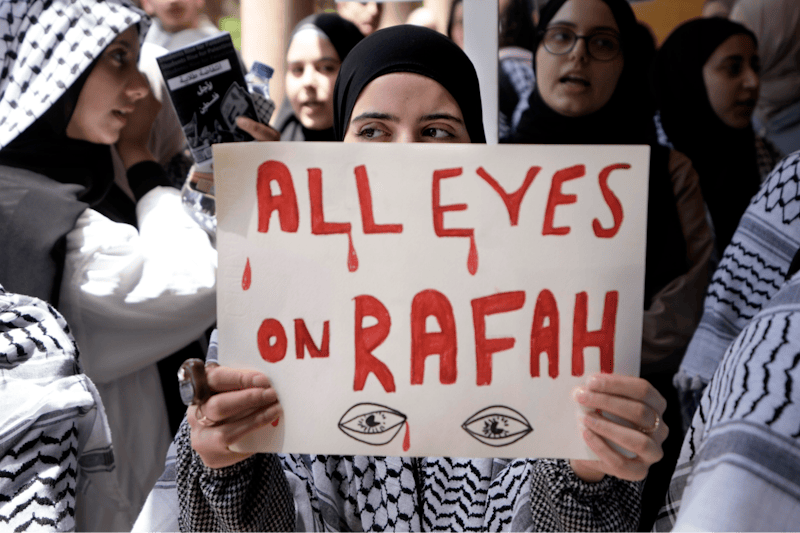
In the first year after Oct 7, you were still in Egypt. How was the movement there? And how would you compare it with the movement in Belgium?
First of all, Egypt is a kind of agent for Europe in the so-called Palestinian-Israeli conflict. Europe has given El-Sisi its blessing, our dictator, who has the upper hand on the Rafah border, managing it for the Israelis and Europeans. Whatever repressive measures he takes in Egypt, they are blessed by Europe. This complicates things because the hope of overthrowing a dictatorship depends on international solidarity, and people therefore look to international structures such as the EU, which preach human rights, etc. However, the EU funds El-Sisi to act as a border guard — against refugees. It is how the border is turned into an economy — against Palestinians. Moreover, Egypt makes each Palestinian pay $5,000 to pass, basically exploiting the genocide. Meanwhile, in Egypt, the repression is severe. People get arrested and disappear by the dozens. At this moment, there are people behind bars in Egypt for organising and speaking up for Palestine. There is basically no movement able to sustain itself for more than a day. We have about one location to protest: the stairs of the press syndicate in Egypt, only because the police are legally not allowed to arrest people on those stairs. So, people meet for an hour and then hide again. They are brave though. For the past three years, people have not worn face masks wherever they go. However, because people are fighting many struggles, economic struggles, neighbourhood struggles, Palestine almost sounds like a niche cause. After all, many people in Egypt are poor, struggling daily for money. But I don’t want to be dismissive of the fears people have in Belgium. After all, I see potential in the solidarity movement, and I want others to see it too. Coming from Egypt, I see how the movement in Belgium can breathe and flourish. The security tech industry is getting stronger, no doubt, but from my perspective and what I have seen so far, security forces in Belgium are still relatively moderate.
What do you mean exactly? Could you give an example?
Not so long ago, there was a big strike, and I found myself in Saint-Gilles (Brussels) with people confronting the police. At one point, the police stopped and formed a corridor, standing in a line and preparing to attack. If you then move back, you normally do so without turning your back on the police, so you can keep an eye on them. Otherwise, you create panic, which is what I saw people doing. And people kept running. They just disappeared without a plan to regroup. Now, I thought that the Belgian police would act like the Egyptian police, running all the way up to you and driving you into an ambush. However, this did not happen, and there was no ambush. We could have regrouped and occupied another square. At least, if there was clear communication, a clear voice shouting in which direction to go and when to stop running. Moreover, things could have been used to mark our territory, such as street furniture and fires. Once, during an action at the European Parliament, I had a confrontation with a security official. He was pushing me back; I was pushing back, and then he started shouting at me in French. I didn’t understand him. So, we kept pushing each other, and I spoke to him directly. Usually, in the heat of the moment, police officers too get an adrenaline rush and forget about their lives and themselves. This happened with the official I am talking about, a man in his 50s. I was asking him: “What will you tell your children tonight?” He was trying to beat me, but I continued asking him: “What will you tell them? What are you doing here?” We kept eye contact. He must have felt disturbed because he shouldn’t be thinking about his family or dinner tonight, and he should lie about his day when he gets home. I was looking him in the face, and people were shouting “free free Palestine”. He then started moving his lips in sync with the slogan! In other words, he was being a coward. Don’t tell me “free free Palestine” while you are attacking me. If you really agree with “free free Palestine”, come stand here with me. Basically, he was telling me: “You know, I am just doing my job; I am actually one of the good guys”. But five minutes later, the police started shooting tear gas and arresting people. I started to get a bit annoyed, to be honest, because I was the only person directly engaging with the police. Perhaps it requires a certain experience. In any case, in Egypt, many of my comrades used these tactics to pressure security forces on the spot and drive them back. And we would find resolution, a way to neutralise the aggression.
As to the solidarity movement in Belgium, I find it great to see university students so involved. However, this also means much coming and going, with little time to become part of a gradually expanding base. There is a lot of lost potential there. In Egypt, the situation is different, with the student movement having little potential due to the high level of state surveillance on campuses. On Belgian campuses, things are more relaxed, but I don’t see that freedom reflected beyond Instagram. In general, my Belgian Instagram is very radical, much more radical than what I see in other places. And there is interesting stuff, creative posts, etc. But again, the content often promotes a wall of invisibility and protection. I think it is mainly because activists have not yet experienced the power of engaging with people barefaced, the power of being recognised also, precisely because you had an impact on people, leading them to join your action. For example, when you return to that bar, cafeteria, or market, where you met those people, they will recognise you, say hello, talk to others, and a community will be building, through random encounters, as it were. It is this randomness that brings people together. And students in Belgium have great potential, but they need more experience, experience with the anger and frustration in society.
It is interesting how you speak of community building, a major concern of young activists in Belgium today. The issue has been neglected but is now increasingly central to our political struggles. Anyway, moving somewhat away now from the solidarity movement with Palestine, could you speak more about your experience during the Arab Spring, the regional process of revolution and counterrevolution also known as the Democratic Spring?
As is known, in the winter of 2010, a street vendor in Tunisia was humiliated by police forces and decided to set himself on fire. It sparked demonstrations, and within a few weeks, the head of state fled the country. In Egypt, in 2010, the movement was quite scattered, somewhat resembling the situation in Belgium today. In every city, efforts were scattered between sometimes up to twenty or thirty groups, each doing their thing while somewhat in touch with the others. I wasn’t a member of any group, but because I participated in all their actions, they considered me part of the movement. In other words, I participated in the energy without having to choose one over the other. And each group had its own tactical approach, its own way of mobilising people, through sit-ins, knocking at doors, symbolic actions at work, etc. In general, there was little or no recruitment. We didn’t know how many people exactly were involved in the actions. But we started noticing that the actions were growing. In the end, it only took us a week to realise and reach momentum. There was no clear plan, only a movement and a general goal: to end 60 years of military dictatorship. When this happened in Tunisia, we only had one demonstration planned in Egypt. We would protest for two hours on January 25th against the military dictatorship and the emergency law. That’s all. I did not even want to participate. I had been arrested three months earlier, and my parents also got arrested because of me. I was fed up with those two-hour demonstrations. I was not going, and I told my friends I would stay at home while they went to the demonstration to make recordings. That is, I would stay close to the phone and in touch with the lawyers, and if someone got into trouble, that person could call me, so I could report the case. Now, over the 10 years preceding 2011, the largest demonstration against the government had been around 5,000 people. We were hoping to reach around 10,000 people on January 25th. But by 3 pm we were already 15,000; by 4 pm, 30,000; by 5 pm, 50,000, etc. The government began acting in ways we had never seen before. I then shut down my laptop and went out into the streets. This is what I had been waiting for. It is how things happened. And it was only the start. Within two weeks, we had 22 million people in the streets.
Could you explain more in detail how January 25th turned into a revolution?
Well, demonstrations should act like growing snowballs, right? So, we would march, and everyone we encountered had to join us: people in bars, restaurants, sitting on a square, etc. The idea was to arrive at point B with more people than we started with at point A. On January 25th, we had 5,000 people gather at six predetermined locations. But we finally all met at Tahrir Square, which was not decided beforehand. Tahrir Square happened because people kept joining the marches from everywhere. People kept marching, and since they had nowhere else to go, they all ended up in Tahrir Square. Meanwhile, security forces were taken by surprise. They had never seen such masses before. In other words, the capacity of the state to control people was crowded out. And the snowball effect continued. We realised this by the end of the day, when the leaders of all the different groups also got in touch. By the way, when you go for so long in the streets, the battery on your phone dies at some point, and so many people are cut off from the internet. We thus discovered a new feeling, with tens of thousands of people at once. And people discovered how things could quickly evolve. First, the chants were about the emergency law, but by 9 pm in Tahrir Square, the chants were about the regime having to change. Meanwhile, people continued to arrive, and we saw how the protest led us to a different level of engagement. The police started shooting and tear-gassing us, and people got injured. But people saw that state power was also being pushed back. The police were not managing to do their job effectively, and chaos was spreading.
Later, I wrote an article about this revolutionary action day, for which I was arrested two years ago. In the article, I discussed the three elements of revolutionary action: consciousness, organising, and spontaneity. The last two seem contradictory, but you need both. Revolutionary action can only start from a fair level of organising. However, it has to allow itself flexibility, which may push the organising beyond itself, beyond its capacity to stop the spontaneity. That is the contradiction. The specific contribution of organising is to provide the spontaneous movement with some guidance. When the spontaneous movement becomes extremely angry and starts banging walls, it needs to remember its chants. It is how consciousness manifests itself, the third or first element, going hand in hand with the other elements. The three elements do not form a linear sequence. Things do not end in spontaneity, with people burning a few police cars and then going home. In such a case, there is no actual building-up, no organising which gives guidance to the growing spontaneity. Instead, people get scared, which happened to us. We reached millions and then got scared. We started asking what was next. Of course, it was the military who was next, who was better organised than we were. We could have done more with the momentum, but we were not able to foresee what we needed: a sustained program; and not just control but growing consciousness; the determination not to leave before things are done.
Commentators have indeed spoken of the Arab Spring as a revolution without a revolutionary program, a revolution with revolutionaries. How did you participate in the organising efforts of the revolution — the democratic efforts of organising with the people?
I became politically conscious during the April 6 Youth Movement in the years before the revolution. It was a movement that co-developed with the important labour strikes in Mahala in 2008. I joined the activities in 2010 when I was only 17. Actually, I was joining almost every young emerging group calling for action at the time. Most actions concentrated on freeing prisoners from other movements, which were seemingly local struggles, not relevant to the nation as a whole. Still, we tried to frame things in a way to gain solidarity from other people, not just students, who then became part of the organising base. In my city, Port Said, I was active with three or four groups within the movement. We would constantly have formal or informal meetings. The movement was so consistent that almost every day, something was happening. And there was an openness that allowed the movement to expand, enabling people to understand the point of agitation and unrest. For instance, we never asked for permission to demonstrate, thus creating some unrest. When you ask for permission, people organise their day around the demonstration. They make it into a nice day. However, when people don’t know when they will return home, they truly face the movement, and the potential of recruitment increases. If people come from afar, with premeditated intent, they are unlikely to encounter the real situation. You need the local people to engage.
In Brussels, there have been attempts in this direction, with people marching in popular neighbourhoods, such as Molenbeek.
That is very interesting. But it is necessary to recruit, follow up, and engage with people, not based on their national number, but based on a way of organising that motivates people to actually participate. I am not speaking of Instagram accounts with 4,000 followers, because if something happens to the account’s owner, what about those followers? Instead, direct engagement is needed: small but meaningful tasks, which also give people the joy of belonging to something and the confidence of saying who they are, what they do, how they struggle, etc. However, in Egypt, we got into trouble because two other organisations overpowered us: the armed forces and the Muslim Brotherhood, which had a base in every city and town and important contacts with the media. But we resisted thanks to our strong social media presence. Of course, by 2012, the state learned that Facebook and social media are important. I think the whole world learned this following the Egyptian revolution, Occupy, and other movements. Anyway, the power of social media was finally seized by the best organised, and the best organised are those who manage to spread their political message everywhere, also without the internet. It is how we finally got exposed as too unorganised, namely when people returned home from protesting without politics actually continuing. After all, tens of thousands, or even hundreds of thousands, of people lost their jobs during the revolution. Even worse, the military spread the message that the reason for this was precisely the revolution. We therefore advanced a counternarrative, explaining that revolutions involve some people losing their jobs, people who were anyway paid under the minimum wage, people who have nothing to lose, people who will continue to struggle, people who are really needed.
And what role did labour organising play?
To start, the unions were immediately subjugated. I don’t know exactly the situation in Belgium, but the Egyptian union leaders were all tied to the state, state loyalists who shut down all revolutionary action in the name of the union. And the alternative unions that emerged after the revolution were quickly shut down because of the legal requirements imposed on them. I often forget, and I feel guilty of almost forgetting again, but I want to stress the crucial importance of labour struggles during the revolution: the millions who got organised to strike, who blocked the roads between cities, who pushed the security forces back, etc. People stopped the wheel of production. This is when the protest actually forced the regime to step down. Unfortunately, when people returned to their jobs, they were left alone; they were left unengaged by purely political demands that did not speak to them anymore. A new constitution is fine, but are labour issues incorporated into it? Are labour struggles advancing? Not enough attention was paid to this question. Instead, a more elitist discourse on civil councils arose, distracting many, including myself. Politics was moving away from the concerns of the average person who, like me, needed to work for a living and yet participated in the revolution. Narratives started spreading that eliminated certain participants of the revolution from its history. For example, the revolution was called the revolution of the youth, which seems to designate the demographic that participated in it. But this is wrong since people of all ages were active. We can see the same thing with the so-called Gen Z protests in Morocco. When things are framed like this, the movement seems to be about young, wild, ignorant people. Again, this is not true. A movement is about the things that move people. By the way, I was personally guided by the experience and wisdom of older people who had been struggling for years and had developed ideas on how to precisely continue struggling.
And are the former activists from the Arab Spring sharing their experiences with young people today? I mean, the question is also about you and the legacy you carry as a political refugee now.
The article I wrote, which eventually brought me here, focused precisely on the question of knowledge transmission, bridging and communicating the things we failed at. I think we mainly failed at developing a program that could act as a compass. The next generation of revolutionaries should be attentive to this. Many things cannot be foreseen, but something should be prepared, enabling people to wait and be patient, enabling them to stay and not go home tonight. You know, something for us to watch, so we can actually try to catch it. I would like to contrast this with social media, Instagram, TikTok, etc., which is what people are watching today. There are politically radical ideas present on social media, depending on the algorithm, yet the link to a political program is poor, as well as the link to physical places, where you can go to discuss politics and engage, still today. But I am learning. I am learning from young people in Belgium. Anyway, I think the role I can play at the moment is to transmit experience. The alternative would be to drown in the despair and depression of my fellow revolutionary Egyptians, seeing how many comrades are in prison, dead, or have disappeared. But I am not there anymore. I am not living the Egyptian oppression anymore. I am searching for where I can invest my energy here. And I think the question of solidarity is key in this search. I am trying to survive, and so are you, and so are we, and so we struggle together in solidarity. But I need to be open and generous first. After all, I have enjoyed education and other things, things I can share.
I want to come back to Palestine. There is a long tradition of revolutionaries in the region stressing the dialectical relationship between the Palestinian and Arab struggles — from Ghassan Kanafani to Georges Abdallah. What is your experience with this two- or multiple-way relationship?
I was born in Port Said, in northern Egypt. Historically, Israel struck Port Said several times, each time while also striking Palestine, of course. Both my mother and father have been refugees because of Israel, always with Palestine in mind. So, there is something very personal about that relationship you are mentioning. Israel always had a lot of enemies in the Arab world because it also strikes civilians in Jordan, Syria, Egypt, etc. However, from the 70s onwards, following the death of Nasser, the Arab governments started to develop their position on Israel along two lines. On the one hand, they increasingly became complicit with Israel by subjugating their economies to organisations such as the World Bank, the IMF, the EU, etc. On the other hand, they increasingly repressed any pro-Palestinian movement at home. For example, Egypt was the first to sign a peace treaty with Israel in 1979, following the Camp David Accords. Camp David stipulated that the US would give Egypt massive military aid and continue its aid to Israel, while Israel would not undertake any military action against Egypt. Nowadays, Israel is openly moving to full military-industrial independence, as Netanyahu announced several times. In other words, Camp David will probably become redundant in the near future, which means Arab governments will lose a lot of their security. Hopefully, this might change some things for the better, but for the moment, it hasn’t.
And how did you personally become conscious of the relationship between Egypt and Palestine, basically your relationship as an Egyptian to Palestinians?
The first demonstration I joined was during the second Intifada in 2000. I was still a kid. It was at school. At the end of the day, the school teachers and all the students went out in a march across the city. I remember being happy, chanting. From then on, my consciousness about imperialism only grew. In 2003, with the Iraq war, I learned more about imperialism, seeing how American vessels carrying weapons passed by my city at the Suez Canal. To contain the city’s anger, the government would shut down all lights for three hours until the ships had passed. I remember the agitation that I felt one night, as a child of 12 or 13, the agitation of the bodies around me, realising that we were helping the Americans to kill Iraqis. The next morning, we heard on the radio how Baghdad had been struck. Why did our city allow this? At the same time, my growing consciousness was about the different layers of margins I belong to. On a global scale, I belong to the margin called Egypt, part of the Global South. But I belong to a margin of that margin, which is Port Said and not the capital of Egypt, so away from any leadership. And I belong to another margin by class, the margin of the working class. During the 2011 revolution, Palestine was present everywhere in the squares. Consciousness was growing about liberation having to pass through Jerusalem, Palestine, Gaza. In the first years after the revolution, Egyptian activists organised a yearly convoy from Cairo to Gaza. Sadly, the donations never reached their destination because of the repression. And our military state blocked any mobilisation in support of the convoys, sometimes also coming from Morocco or Tunisia. We would feel ashamed but also joke about our Moroccan and Tunisian friends getting arrested as proper Egyptians. The regime did not care and treated us all the same, violently repressing us all.
Actually, I am also ashamed as an Egyptian each time I meet a Palestinian, especially since Oct 7. Basically, I just say sorry. I am sorry because my country is a partner in the siege of Gaza, and I cannot do anything. Israel is the one deciding that crossing the border is only possible in Rafah. But Egypt should at least make the crossing free. There are people at the border missing a leg and running away anyway, missing other limbs, missing their family. To use the border as a cash cow is very shameful. Meanwhile, the regime continues arresting my activist friends in Cairo. In general, I am often critical of performative politics, including boycott campaigns: don’t drink Coca-Cola, don’t buy this or that. I am critical because it is the least people can do. It is a good thing, but nothing to be particularly proud of. In the Egyptian context, however, it was finally the only thing we could do without getting arrested. People got arrested even for collecting donations for a Palestinian family to cross the border. The Egyptian regime thinks that any mobilisation is risky for its survival. So, when we started demonstrating right after Oct 7, the dictatorship immediately became anxious that the demonstrations would turn into something else, related to social justice. The regime therefore cracked down on the demonstrations, much more aggressively than could happen in Belgium. In contrast, there are acts of solidarity in Egypt regarding Palestine that do not exist in Belgium. For example, when I went to the Stop Elbit action where you and I met, I was shocked to learn that people were risking a bill of 60.000 or 70.000 euros, of which 20.000 euros would go to lawyers. This is mad. In Egypt, there are no lawyers who accept payment to defend a political case. I mean, a symbolic payment would be accepted, for instance, to cover the rent of the lawyer’s office. But 20.000 for a lawyer? I talked about this with one of the seven activists sued by OIP-Elbit. The person simply took the issue as how things are. I am sure there would be lawyers familiar with the subject and willing to take on the case without charging a fee. There must be lawyers in the movement.
It is interesting how you brought up the question of shame. Do you observe shame among the Arab communities in Belgium — shame in relation to the Palestinians ?
I observe shame on different levels. I saw that Moroccans were really excited following their recent convoy travelling across North Africa. It showed that Moroccans could actually do something. And what about Egyptians? After all, Egypt accounts for one quarter of the Arab world, with a population of 120 million. The army, however, counts about 2 million people, which is a huge burden on society [note: Israel, Syria, Lebanon, and Jordan are all in the top 10 of countries with the highest ratio by active military personnel]. I also see how people live double lives, such as the Moroccans again, who feel great shame about their government repressing the pro-Palestinian movement, but then they love their king. Each time I enter the spaces of the Moroccan community, I see pictures of their king. This is strange to me. As to the Palestinians in Belgium, I see different things. There are the people I meet at the Bourse protests, basically working-class asylum seekers struggling for hope beyond their struggle for daily survival. But I notice the depression wearing on their faces, also because of not having a job. These are people who are in daily communication with the struggle back home. I am not. I follow the news. They are following their families – a totally different state of mind, often involving a certain cynicism towards people like me. Of course, they really appreciate people coming to the demonstration. But people come for an hour and leave, while they stay for the whole day, smoking their cigarettes, not going anywhere. I can feel the cynicism when we have a cigarette together. They are thinking about how I will leave in a minute. Next, there are the schooled middle class, probably second-generation Palestinians. They are much calmer, breathe, assume the dialogue, and are much more assertive. The different groups of Palestinians also tend towards different types of action, different layers of action. Finally, there is a third group, namely the Palestinians in the bubble of the EU, the NGOs, etc. They are happily working for Amnesty International or other organisations, but actually, they are completely isolated. It’s a shame. They are the ones who, for instance, will never mention George Abdallah, because they are ashamed of such figures. Some Palestinians celebrate his freedom, and others remain silent. The case of Mohammed Khatid [the European coordinator for Samidoun] is similar. His case is unprecedented in international law, with basically his oppressor [Israel] demanding that Belgium cancel his refugee status, and with Belgium giving in. I thought this would become an important case for all those NGOs working on migration. But not a word. They are not doing their job. They should document and highlight cases such as those of Abdallah or Khatib. This would help the Palestinians. It would help build solidarity, starting with some communication, an article, something. An email could be sent to the project coordinators of the top NGOs every day, causing them headaches. Leaflets and posters could be placed at their headquarters repeatedly. It could really help push solidarity towards a new political momentum.
Clearly, there are huge challenges to the dialectics between the Palestinian, Arab, and other regional struggles. Soaring contradictions seem to leave little room for new emancipatory coalitions across the region. Today’s capitalist imperialism is responsible, but so are the forces that could change the situation. The forces of change are wrestling with the question of internationalism. It’s a struggle. In the region, the political dynamic between the Palestinian leadership, also the Palestinian left, and other regional revolutionary forces has been quite poor lately — regional solidarity from below is lacking. In this context, Georges Abdallah speaks of a feeling of shame among Arabs in the region, especially seeing how people worldwide have taken important risks to help Palestinians, while the Arab popular masses have remained relatively passive. Abdallah asks: “How many have died in confrontation with the police during protests in the Arab world?” But he adds that the shame cannot and will not last. Do you agree with this analysis of shame in the region as both a passive attitude and a promise of revolt, if not revolution?
Yes, the efforts worldwide have been great, also those by the people I referred to by their performative politics. Climate activists have shifted their cause in admirable ways. And they are again mobilising for a new convoy to Gaza. Anyway, the shame flowing from an incapacity is always complex. People feel ashamed when they realise how incapacitated they are as individuals or a group organising itself — sometimes due to direct repression. People feel ashamed of their political leadership, which importantly determines their politics. I think shame can push people into a very, very passive place. Probably, anger and agitation are needed to counterbalance. The problem in Egypt, a quarter of the Arab world, as mentioned, is that people are exhausted, exhausted by their daily economic struggles, which are part of that system of repression, a global repression. El-Sisi is keeping the country drowning in debt, and the global neoliberal system is rewarding El-Sisi for it: as long as Egypt fulfills its role as border guard, the system will write off certain amounts of the debt. The system is not only allowing the dictator to stay in power but also giving him a reason and a right to do so, namely so that the Egyptian economy would perform well. Meanwhile, the despair among Egyptians continues growing because there seems to be no way out of the dictatorship. People thought the only way out would involve international support, but the so-called international community is allowing even a genocide to continue, much like it is allowing El-Sisi to stay in power. People are exhausted from all this. I talk to my friends in Egypt all the time, and they are simply at home, exhausted, which is somewhat odd, because they are not doing much, merely following the news, basically feeling ashamed and incapacitated. They don’t have an outlet for their emotions. The Egyptian solidarity movement with Palestine is on the couch and totally incapacitating. I don’t want to get too close to that desperate state, of which there seems no way out. It is why I am looking into other things for now. Maybe this is not the time of great debates about the most effective action possible. Maybe this is rather a time for communication and education – not only in Egypt but also in Brussels, in Europe –, a time to build through study over the next 10 to 20 years. However, I know I will be part of a revolution again. I don’t know where or when, maybe in 20, maybe in 30 years, but I know it will happen. We will see then.
Yes, we cannot predict the future, but there are different ways of living and organising towards it. There are different ways of feeling our time. It is why the question of the passions or emotions — for instance, shame — is important, I think. It also connects to the question of what we actually desire. Could you speak a bit more about the emotions of people in the region regarding Palestine, and how they act out what they feel?
Shame is certainly in the center. Many people are deeply ashamed. Let me give you an example. In the first year after 7 October 2023, when I was still in Egypt, I could not wear the keffiyeh. Can you imagine? I only had the freedom to wear the keffiyeh outside my home when I arrived here in Belgium. In Egypt, I would be stopped and arrested by the police immediately. And to just wave a Palestinian flag out of a car is seen as very brave. Anyway, I think the feeling of shame among politically conscious people connects to the belief that something could or should be done. It remains unclear what, but something is possible, since people cannot admit that they have tried everything. I know this idea exists among activists in Egypt, the idea that something could or should be done, even if seemingly impossible, considering that each time something is organised, all organisers are arrested. All my friends organising for Palestine have been arrested, put under surveillance, made inactive. And again, you cannot imagine the level of economic despair. For example, after 30 years of teaching, my mother receives a pension of around 28 euros per month, and this is just average. She is not among the poorest. Up to 70% of Egyptians struggle with work, with making a living, basically the working class. And if you talk to these people who are hungry and tell them an action is happening in solidarity with Palestine, they will tell you that their hearts go out to the Palestinians, but that they do not even have money for the bus to go and arrange their administration. Finally, people are scared, not like here in Belgium. There is a general state of paranoia. If someone tries to talk you into an action or talks to you during the action, people think a security agent is testing you. Personally, I was lucky to be able to hide behind my work as a journalist for many years. I was much less at risk while still present during those actions. I managed to remain somewhat relevant to the movement through my camera and my writing.
This approach has also been developing in Belgian activist circles over the last few years. People are very concerned with the repression and may therefore prefer to act as journalists, sometimes in combination with that politics of invisibility you mentioned. It is all quite linked to social media, of course.
There are two things I have observed. I have seen reporting limited to content creation. That is wrong, I think. The power of reporting lies rather in taking your camera or pen directly to the people. You ask them about that huge weapons fair in Brussels and you focus on the indignation, the anger, even just for a minute. People always have a minute, right? And then you share locally among people through social media networks in different neighbourhoods, connecting them as a base. This is how we used Facebook to mobilise 15 years ago. It is how we got the word out…
We are reaching the end of this conversation. Regarding Palestine, and with Solidarity and others, we are trying to nurture perspectives of regional solidarity from below, revolutionary dialectics, while understanding the role of emotions, both individually and on a mass scale. And we are learning a lot from your experiences during the Arab Spring and here in Belgium. Thank you for sharing. I hope we can continue the conversation. But for now, I want to end by asking about your hopes and concerns, both for yourself and the larger solidarity movement?
Two major correlations are happening: the rapid progression of imperialist aggression across the Global South and the closure of borders. This is very concerning, because where will people run towards? The EU has recently adopted a new migration pact, making the protection of people harder. I am one of the last people who were lucky enough to get protection last year in Belgium. I am relieved I found a safe refuge, but I am very concerned about all the others indirectly impacted by the growing war machine. There is much less empathy towards them. The left is concerned with values such as freedom of movement, freedom of expression, and opposition to war, which should all foster empathy for refugees. For the right, the question of the refugees is merely one of accounting numbers, refugees stealing jobs. But there is another way of doing the math. People should understand that the Belgian and European investments in the war machine will lead to catastrophes and more refugees. The question of the refugees should be tackled by stopping the war machine. It is directly connected to imperialism. People run away from dictatorships and wars. Therefore, to invest in the war machine and close the borders is the cruelest thing you can do. Soon enough, Europeans will discover this. And sadly, the money going into wars and dictatorships is the money of poor people here. It is agitating poor people in Europe against poor people elsewhere. It is making them vote for the nationalist right and far-right. The left should not address these people with arguments about empathy, freedom of movement, or human rights. The left should address them with the right math. More than 20 years ago, a program was introduced called the European Migration Control. It was based on paying dictators such as Gaddafi in Libya to stop refugees from coming to Europe. And you, Europe, would close your eyes to these dictators. Today, refugees are still being slaughtered in refugee camps in Libya. But people always find ways to survive, moving through Hungary or other places. So, the refugees keep coming, the economy does not improve, and people vote for warmongers.
Personally, I am now enjoying a place where I can breathe. I have the luxury of looking around for active comrades with whom I can connect. But I am sometimes concerned about losing touch with direct action and the movement, despite my efforts to follow up. In Egypt, both my flatmates were politically very engaged. I did not have to leave my home for a few hours every few days in order to belong to the movement. I experienced agitation and participated in the creative political energy nonstop. In Belgium, I often feel like a guest or tourist at events. This is a completely new position for me. In the last 15 years, I have always known the organisers, thought along, actively helped, etc. Of course, the guest’s position is not bad. I go around talking to different people, though without much purpose, feeling a void. And I observe that this void exists among many people and groups. But maybe the question of activity has changed meaning. Many people are active as users or followers on Instagram and other social media platforms. I still think of being politically active in terms of meeting every day and letting the anger out every day. I would not always meet with the same people, but I knew where to go after work for a political discussion every day. I have not discovered this yet in Belgium. Maybe it is considered a luxury. After all, most active people are probably from a schooled middle-class background, so they are not constantly angry and agitated for not having enough money. In Egypt, the lack of money was keeping us going. However, today I feel quite far from this working-class base, which was fully part of my life in Egypt, even though I lived between two worlds: as a reporter for major international media and as a friend and fellow activist of all the people with whom I participated in the revolution. In short, I am still trying to find my way.