(Note: this article has been written and shared internally before the action at the tribunal of Oudenaarde on February the 17th)
‘Listen—not just to our words, but to what lies between them. In that silence lies the truth of Gaza.’ – Taqwa Ahmed Al-Wawi
There is a certain silence surrounding Gaza. The last mass mobilisation in Belgium dates back to 7 September 2025. A month later, several thousand people gathered in Brussels in solidarity with the Global Sumud Flotilla. Since then, the actions have continued on a smaller scale. Every week, people gather in various cities to reaffirm their loyalty to the Palestinian resistance. But repression is making itself felt, as is a certain hesitation within the broader movement.
It is clear that the agreement between Israel and Hamas, adopted on 10 October 2025, is having an impact on the movement in Belgium and worldwide. It is now the colonial plans for Gaza that dominate the bourgeois media, alongside the ongoing violations of the agreement by Israhell and the direct murder of hundreds of Palestinians and Lebanese. Phase one of the agreement, consisting of Trump’s 20-point plan, has not been implemented as agreed: deadly zionist violence continued, humanitarian aid was blocked, the occupying army withdrew only partially, etc. Meanwhile, phase two has begun, focusing on ‘demilitarisation, technocratic governance and reconstruction’. On 22 January 2026, Trump presented his Board of Peace to the global elites in Davos, intended to implement the second phase. This body of “peace” is an imperialist vehicle filled with autocrats and capitalists and aimed at further marginalising and keeping ordinary people in Palestine and the region under colonial rule.
In this context, Abu Amir, a resident of Gaza, asks: ‘Will the Palestinians succeed in bringing their cause back to the table after it has been deliberately sidelined? Or are we facing a new period of conflict management rather than conflict resolution?’ Abu Amir is well aware that justice is being buried, because the ‘conflict’ will indeed be managed. The word will be sanitised. It will no longer pose a real threat, rendering resistance to injustice meaningless, silenced. In short, “peace” will reign. Or, as imperialist logic goes: ‘They create a desert and call it “peace”.’
At this moment, Gaza and the Palestinians are in greater danger than ever of ending up in such a desert of loneliness. Their voice and struggle will be “pacified”. Far-right zionists are eager to take the lead in this violent process. For example, Smotrich, Minister of Finance, has repeatedly stated in recent weeks that he does not want to wait for Trump and international imperialism to completely disarm and destroy the opposition, particularly Hamas. Fascism is doing its usual work here as the local vanguard of systemic violence. Genocide and expulsion are becoming part of big capital’s strategy to tap into new markets: Gaza as a ‘real estate bonanza’ according to Smotrich or ‘Riviera of the Middle East’ according to Trump.
At the same time, Trump is irritated by the escalating fascism in Israel. It risks postponing any “peace plan” – and with it Trump’s grotesque plan to commercialise Gaza. But Trump is a fascist himself, eagerly siding with Netanyahu while actively organising fascist forces in his own country through ICE. Trump, however, is also a businessman who wants to make deals to conquer the global market. On the other hand, Hamas is trying to buy time by agreeing to the second phase but communicating unclearly about disarmament. Hamas agrees to a technocratic government while seeking ways to remain indirectly in power and retain its weapons. To this end, Hamas is seeking a new national balance in relation to the other political forces in Palestinian society, in particular by partially agreeing to the pacification of Gaza, the pacification of the masses and their popular resistance.
It is indeed the popular masses in Gaza and Palestine who we hear the least from in this whole affair because they are to be the most feared. They could call the entire peace plan into question, because they are, after all, the ones who will have to live in that desert, a life with little hope, that is to say, politically without prospects. This harsh reality cannot be ignored. The loneliness is real. That is why a political alternative is more necessary than ever. Strategic alliances are needed to break through the loneliness, revolutionary alliances that can give the popular masses the confidence to take their national struggle to a higher level, a new intifada towards a different system.
In other words, the question of revolutionary alliances is posed. History shows that the Palestinian struggle is closely linked to the struggle of the popular masses in the region. In this sense, more attention needs to be paid to regional solidarity from below. A few months ago, the latest mass mobilisations in solidarity with Palestine took place in Tunisia and Morocco, particularly in the weeks leading up to the ceasefire. More recently, militant protests for social and political justice have also taken place in both countries. And in Somalia, a large wave of protests and solidarity with the Palestinians erupted at the end of December when Somaliland was recognised as independent by Israel, the only UN member to do so thus far. But otherwise, popular solidarity with Palestine has remained rather quiet in recent months. Moreover, repression against the movement continued in Egypt and Jordan, while the popular masses in Rojava, Iran and elsewhere suffered heavy losses…
In short, grassroots regional solidarity is being politically stifled under the current governments and dictators, supported by regional and global imperialists and big capital. This makes revolutionary alliances extremely difficult, but no less necessary, meaning the need for a renewal of militant internationalism. Such internationalism should enable the popular masses to form alliances against imperialism and its structural interests in fossil fuels and trade routes in the region. After all, the rule of capital is murderous, and alliances will be forged in order to resist it. In this sense, the Palestinian and regional masses, driven by the diverse working class, represent the hope for a revolutionary internationalism of the living forces, a real movement that will overturn the current situation, and in particular the zionist state. And in this sense, a perspective could open up for the overthrow of capitalism in the region and a democratic socialist solution to national oppression, genocide and poverty.
Stop Elbit! Free Palestine!
During a recent demonstration in Brussels in solidarity with the uprising in Iran, an Iranian activist took the floor: ‘Solidarity with the Iranian people / and yes, we are sad and in pain / but we need more than just sadness / we need struggle / and we also need your struggle / you must struggle in Belgium and Europe / against fascism, militarisation and imperialism.’ Indeed, in Belgium and Europe, imperialism has been high on the agenda since Russia’s attack on Ukraine in 2022, preceded by rising tensions in the region, and certainly since the unprecedented movement in solidarity with Palestine and against zionism and genocide. Immediately linked to this are militarisation and a certain resurgence of the far right, which is weighing increasingly heavily on the politics of the Belgian and European elites. Although various forces are involved in these developments, zionism (and the struggle against it) clearly plays a crucial role in relation to both phenomena and Belgian and European imperialism.
But for some on the left, the analysis of imperialism translates into a disconnect between geopolitical analysis and domestic social struggle, losing sight of the interrelationship between the two and thus failing to achieve a better understanding of imperialism, i.e. better methods of struggle. In short, imperialist developments are reduced to a question of camps: the West (the US and Europe) and the rest. This is usually accompanied by an equally simplistic view of capitalism: the bourgeoisie (the rich) and the rest. Such campism obscures the complex interrelationship between the various forms of oppression and exploitation in the world. It therefore constitutes an obstacle to the development of a revolutionary internationalism based on solidarity between oppressed peoples and the diverse working class. At the same time, campism risks leaving room for the far-right and militarisation at home, particularly by reducing social struggle to a question of purchasing power and jobs without emphasising its (geo)political dimensions. On the other hand, campism also leads to a distant or even cynical attitude befitting the moral superiority of those who supposedly already belong to the right camp and no longer need to make any effort to better understand the complexity of the situation. In short, the left faces important political challenges.
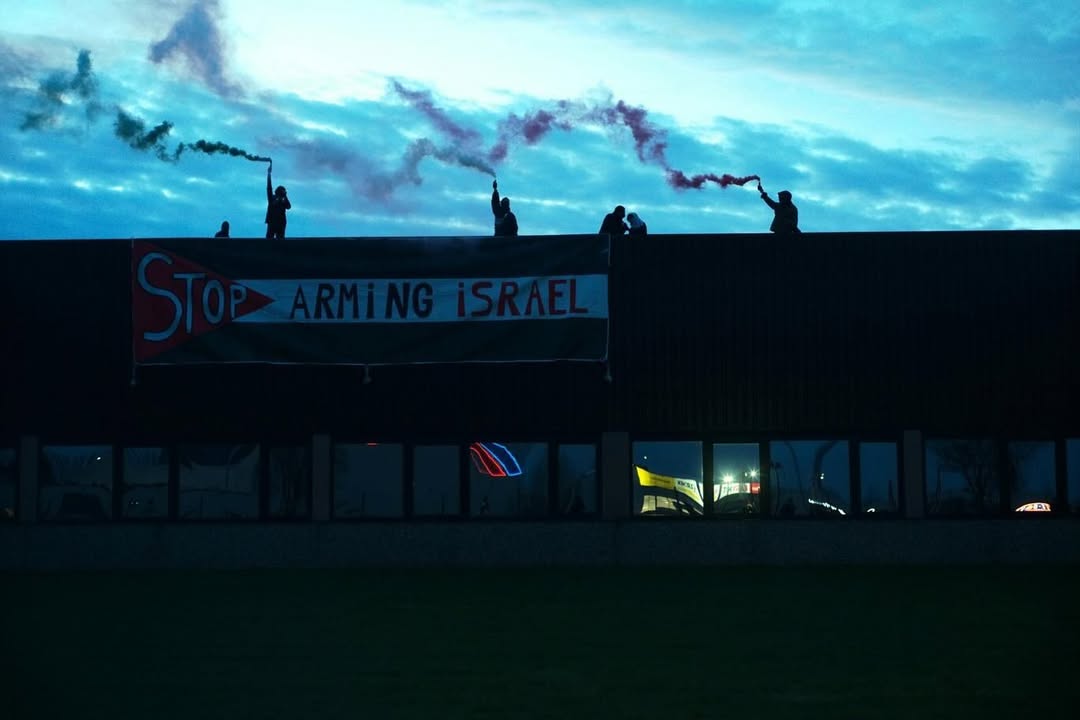
It is in this context that the struggle for a free Palestine continues. Boycott remains on the agenda, but the mass movement in Belgium is currently somewhat quieter, as mentioned. In addition, more radical direct actions are currently staying under the radar. After all, repression has increased in recent times, including soft repression that sows fear and confusion within the movement and causes activists to doubt their political commitment. Resistance and solidarity are an essential antidote to the influence of fascism and militarisation in society. A number of important actions in solidarity with Palestine have made this point: direct actions in 2024 targeting Challenge at Liège airport, Thales in Herstal and OIP-Elbit in Oudenaarde or ZIM at the port of Antwerp; larger direct actions co-organised by Stop Arming Israel last June and October (with a victory over police violence thanks to an alliance with the local trade union and workers); actions in solidarity with Palestinian refugees confronted with state violence or even driven to death; etc. In other words, while capitalist imperialism pursues profit, we resist in solidarity with the victims of violence and repression, and with each other. In this way, our resistance shows how the system works and opens the way to an alternative.
In other words, radical direct actions have brought political oxygen to the solidarity movement, but in the meantime, the situation in Belgium has also escalated. Seven activists have been charged for blocking the OIP site in Oudenaarde on 4 March 2024, together with a hundred other activists, following an international call to action. OIP is a Belgian company owned by Elbit Systems, the main national arms supplier to the zionist occupation army. OIP-Elbit is therefore part of the genocide industry and is dragging Belgian society towards militarisation and the normalisation of zionism. For example, the Vrije Universiteit Brussel recently announced a new collaboration with OIP-Elbit. In this way, the genocide industry continues to operate, unless it is stopped by those who want to put an end to zionist violence and its imperialist infrastructure. That is why the seven activists prosecuted by OIP-Elbit deserve the full support of the solidarity movement with Palestine.
In the United Kingdom, the witch hunt against activists involved in similar direct actions has been going on for some time. The targeted organisation is Palestine Action, which has fought a successful international battle against Elbit Systems. On 5 July 2025, Palestine Action was banned as a terrorist organisation by the UK, but some activists have been detained without trial since 2024. Recently, several of them went on hunger strike in solidarity with Palestinians who have long used such and other methods to keep their struggle alive, particularly in Israeli prisons. Recently, six Palestine Action activists were also acquitted by a public jury that could not help but recognise the justice of their resistance. Moreover, the ban on Palestine Action was lifted on 13 February 2026 by the High Court in London. Although the Belgian situation is different, there are important lessons to be learned. Victories over the capitalist imperialist system are possible when solidarity and resistance continue, against the genocide industry and with the support of the wider community.
That is why Solidarity calls on people to come to the Oudenaarde court on Tuesday 17 February at 10 a.m. It is necessary to strengthen solidarity with the seven activists who are having a hearing at that time: Stop Elbit! Free Palestine! It is necessary to strengthen the resistance with everyone who is fighting in solidarity with the Palestinians and against imperialism, militarisation and fascism. The political oxygen brought by radical direct action must not be stifled. The broad movement and its various collectives must give voice to this cause at rallies and meetings. Yes, it is possible to rebuild critical mass as during the democratic student occupations and mass mobilisations in 2024. And in this way, the movement can build powerfully towards March: International Women’s Day (8/3), the national anti-Arizona demonstration (12/3), Smash the Bedex arms fair (12/3), International Day Against Racism (21/3), the new Global Sumud Flotilla (29/3), etc. In short, the action on 17 February is an important moment in building our intersectional and internationalist struggle for a different system, for a free Palestine. See you then.