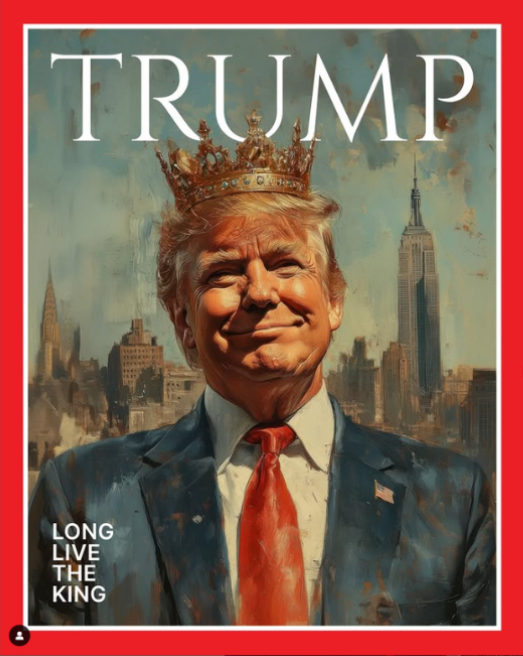
The Arizona government (De Wever–Bouchez–Rousseau–Prévot) is implementing Trumpist policies in Belgium. These are not exact copies of Trump’s policies, but they fit perfectly within the trend towards an authoritarian form of capitalist management. We want to reinforce this argument with a series of articles, of which this is the first. Compared to Trump, De Wever and co. may pay slightly more attention to the packaging of their policies, but the political content is the same. A more brutal and explicitly colonial and imperialist foreign policy is combined with an authoritarian evolution at home, both in terms of democratic and social rights.
The capitalist class is changing tack and wants a more aggressive policy to guarantee its economic and political dominance. The evolution is not one towards more democratisation, a freer world, or the resolution of global problems such as climate change or poverty. This narrative, which was never a real intention but a sales pitch, is now in tatters. It is an evolution towards more and unapologetically brutal colonialism, with results including genocide, towards imperialist struggle, leading to rearmament and war, and towards an authoritarian turn in North America and Western Europe.
Military struggles against competitors and the exploitation of colonial relations go hand in hand with the suppression of all forms of social opposition at home. Trump is already going very far in this regard. De Wever and co. must take into account the power of social resistance, but we should not delude ourselves. Here too, they are exploring all possibilities to do away with democratic and social rights. Their goal is the brutal defence of the Belgian capitalist class, with the aim of an even more massive transfer of global wealth and power from the working class to Belgian and international capital.
Trumpism, Belgian style: authoritarianism and the return of colonialism
Trumpism, or authoritarian capitalism, is not an accident or a temporary result of elections. It is not an anomaly or a purely American phenomenon. It is the extension of an authoritarian capitalist system that has long been common in many countries in the Global South, but which — through class struggle and compromise — had given way to a social pact in the Western imperialist countries. In this pact, parts of the working class were given a form of welfare state and a number of social rights, but the capitalists retained power.
Neoliberalism has brutally shattered that social pact in the West, thereby undermining the social basis for the system. Here too, the rule of capital can no longer be enforced through social dialogue or democratic illusions, but requires brute force. That force has long been used against the most vulnerable and those with the fewest privileges.
The social pact was never one for the entire working class.
The Arizona government has clearly chosen to follow this path. As Minister of Defence, or is it War?, Theo Francken took part in an international conference on mining at the beginning of February. De Morgen spoke with Francken and reported on his new approach:
“According to him, it is time to restore our historical position in the supply of critical raw materials, where possible. He is looking primarily at the African continent, and more specifically at the former Belgian colony of Congo, a country with particularly rich subsoil that has already been extensively mapped. Belgium provides development aid and will soon resume training the Congolese army.”
Belgium has always maintained a neo-colonial relationship with Congo, with the state acting as an accomplice to the interests of Belgian capitalists in the region. What Francken is now advocating is a more aggressive and explicit colonial policy, without too many ethical or moral barriers. In the same interview, he states:
“Typically European, we set the bar far too high for ourselves. You can’t do business in a country like Congo that way. We’re not suddenly more ethical about mining. We’re simply no longer involved in mining.”
He is referring here to European directives that will make companies legally liable for possible human rights and environmental abuses in their supply chains. For Francken, this is too much woke nonsense.
In this, Francken is perfectly in line with the vision defended by Marco Rubio, US Secretary of State, at the Security Conference in Munich. The speech was an unambiguous call to embrace the colonial past of the West and to give new meaning to the Western “civilising mission”. We quote extensively from this speech because it accurately reflects the ideological basis of Trumpism.
“This is the path that President Trump and the United States have taken. It is the path that we ask you here in Europe to walk with us. It is a path we have walked together before and hope to walk together again. For five centuries, until the end of the Second World War, the West was expanding: missionaries, pilgrims, soldiers and explorers poured out from the coasts across the oceans, settled on new continents and built vast empires that stretched across the globe.
But in 1945, for the first time since the age of Columbus, it shrank. Europe lay in ruins. Half of it lived behind an Iron Curtain, and the rest seemed set to follow quickly. The great Western empires had entered into irreversible decline, accelerated by godless communist revolutions and anti-colonial uprisings that would change the world and cover much of the world map with the red hammer and sickle in the years to come.
Against this backdrop, many, then as now, came to believe that the era of Western dominance had come to an end and that our future was destined to be a faint and feeble echo of our past. But together, our predecessors realised that decline was a choice, and it was a choice they refused to make. This is what we have done together before, and this is what President Trump and the United States want to do again, together with you.
And that is why we do not want our allies to be weak, because that makes us weaker. We want allies who can defend themselves, so that no adversary is ever tempted to test our collective strength. That is why we do not want our allies to be shackled by guilt and shame. We want allies who are proud of their culture and heritage, who understand that we are heirs to the same great and noble civilisation, and who, together with us, are willing and able to defend it.”
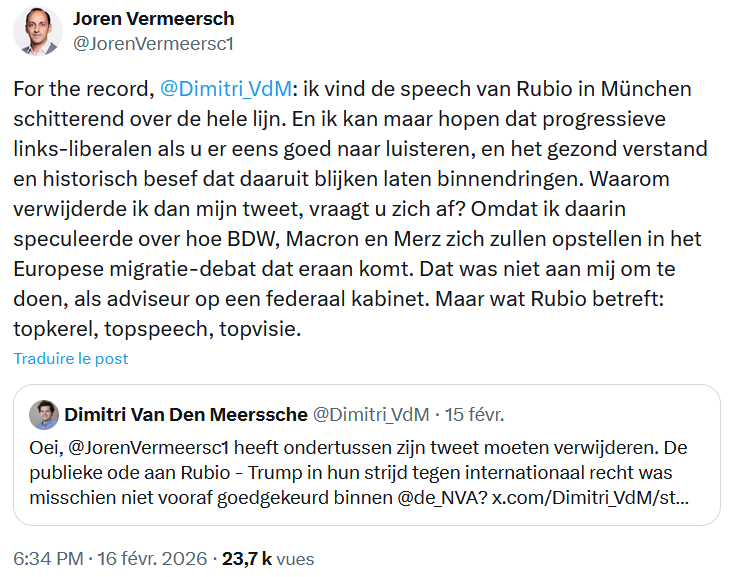
The reaction of Joren Vermeersch, one of the N-VA’s resident ideologues, to the speech was telling. “Top bloke, top speech, top vision.”
The Trump regime is clearly paving the way for like-minded people to bring out their colonial rhetoric and politics more explicitly and without hesitation. In order to increase support for this, reactionary and racist ideas are being systematically spread to justify colonial politics, as in the past.
This explains why, despite impressive movements against all forms of oppression, there is still an increase in explicitly patriarchal, racist, heteronormative, ableist, neurotypical ideas and practices. These ideas are spread in their most explicit form by a radical faction of the far right and are becoming increasingly mainstream. In Belgium, too, the Arizona government ultimately serves this agenda.
In De Morgen, Pieter Stockmans rightly responded:
‘Rubio’s message was not reassuring but alarming: purge Europe of “woke” climate policy, social protection and liberal democracy in exchange for American protection. The fact that Rubio received a standing ovation for this is disturbing.’
Investing in weapons and imperialism
In order to protect the interests of Belgian capital internationally, the government is navigating between an Atlanticist course advocated by Rubio and a laboriously emerging European defence policy with a certain independence from the US. The two are not necessarily mutually exclusive and fit perfectly within the same course towards much more active participation in the struggle for influence and power, with war as the ultimate horizon.
All 18-year-olds in Belgium received a letter calling on them to consider enlisting. The aim was not mass recruitment, but to normalise the idea that war is a reality we must take into account.
The non-profit organisation Vrede showed that Belgian military spending more than doubled between 2015 and 2024: from 3.8 to 7.9 billion euros. According to the government’s Strategic Vision, a jump to 12.76 billion euros was planned for 2025. This jump means that military spending has more than tripled in ten years.
These funds should enable Defence Minister Theo Francken to invest €34 billion in weapons systems over the coming years: drones, fighter jets, frigates, armoured vehicles, air defence, cyber capabilities and ammunition. The arms industry is a big winner. From 12 to 15 March, an arms fair was held at the Heizel in Belgium for the first time. The arms industry, for whom war and genocide are a business model, is enjoying a golden age and is eager to sell its “products” of destruction.
The Belgian army is being prepared for active participation in inter-imperialist rivalries. It is no coincidence that Theo “Trump” Francken is in charge of this: he is one of the most openly Trumpist ministers in Arizona. Foreign Minister Maxime Prévot also subscribes to this logic. A few days into the imperialist war against Iran, he has not ruled out the possibility that our country itself will become involved in the conflict. ‘We must remain vigilant in case our allies in the Gulf states request European support.’
Francken was also one of the fiercest defenders of Israel, Zionism and, ultimately, genocide. On 1 October 2024, he wrote:
‘Looking at the big picture, it is difficult not to support Israel in its geopolitical ambitions. This offers the best guarantees for a secure West.’
The current Zionist state of Israel is an instrument of Western imperialism. The Belgian government leaves no doubt that it will engage in this imperialist logic. Our struggle to invest in social security rather than weapons in Belgium is inextricably linked to the struggle for Palestinian liberation and against imperialist aggression throughout the region.
Racism and criminalisation of opposition
Refugees and undocumented migrants are a priority target group of Trumpism. They can easily be used as scapegoats. When you can break the mechanisms of solidarity with the weakest, you pave the way for undermining the principles of solidarity. Reception centres are disappearing and refugees are being left to fend for themselves. Procedures are being tightened and rights eroded. People are deliberately kept in uncertainty and sometimes literally put out on the street. At the same time, they are portrayed as profiteers who threaten “our” social security, housing and jobs — a politically useful but completely false representation.
In reality, refugees are marginalised by not giving them legal opportunities to build a life in Belgium. This creates a large, disenfranchised reserve of labour that is heavily exploited in sectors such as cleaning, hospitality, logistics, agriculture and care. Their precarious status drives down wages and working conditions for everyone.
Racism functions both as a smokescreen and as a lever here: it divides the working class along racial lines and legitimises authoritarian measures that can later be used against everyone.
The law on the revocation of nationality — whereby persons with dual nationality can be stripped of their Belgian nationality — was passed as a symbolic law. As a result, there are two categories of citizens in Belgium: “real Belgians” and the others. But make no mistake: even “real Belgians” who defend migrants are criminalised and denied their fundamental rights.
This explicitly racist policy serves, on the one hand, as a battering ram to justify colonial policies and, on the other, to dismantle democratic rights at home.
The Belgian Prime Minister has advocated withdrawing from international treaties that guarantee the rights of migrants. The government has been condemned on several occasions but ignores dozens of court rulings. The League for Human Rights comments on this development:
‘What is remarkable about this political moment is that all the pillars of democracy are being undermined at the same time: the rule of law, human rights — civil, political, economic, social and cultural — as well as the principles of equality and non-discrimination.’
Any form of opposition is increasingly criminalised and considered an internal enemy. The Quintin bill, which is being challenged by the Right to Protest coalition, is one example of this. It is a direct attack on our civil rights: it attacks the right of association, restricts freedom of expression and the right to take action and demonstrate.
More and more administrative instruments are being created that enable sanctions and repression. One of the most absurd examples is the fining of chalk drawings with which citizens protest against genocide, racism or sexism. In several cities, such expressions have been sanctioned by local authorities, as if temporary pavement chalk messages pose a threat to public order.
At first glance, this may seem laughable. But repression and discipline do not only take the form of batons or pepper spray. They often take more subtle forms: GAS fines, administrative sanctions, permit conditions, police action without criminal prosecution. These techniques are less visible than physical violence, but no less effective in deterring protest.
The Federal Institute for Human Rights explicitly warns against this in its latest report:
‘In recent years, a clear trend has emerged: … local authorities are taking repressive measures without the same legal safeguards as in criminal proceedings.’
Administrative sanctions allow citizens to be punished without the traditional guarantees of criminal law: no independent judge, a lower threshold of proof, limited opportunities for defence. This will result in a system in which protest and contestation can be sanctioned more quickly and easily.